Thursday, December 10, 2015

TRUST YOUR HEART

"Trust Your Heart To Lead You Home" is a triptych carved on cherry wood panels. This mosaic mock-up is a variation on the third panel, and is my fourth effort at a feasible cyclocentric mosaic in tile. It contains samples of  five polygons not commonly seen in tile in five networks similarly underused, these polygons have all been test cut (with diamond tools) in the sizes necessary to produce this image for a back-splash 41 5/8 in x 87 in.  
These examples represent the smallest pieces I was able to cut consistently. Quite a number of them just broke from the strain, and more than a few were backwards (the wiggle has a direction). It wasn't until later that I realized those backwards pieces were the key to an even odder group of symmetries. I was moving them around wondering just how one might join lefty wiggles to righty ones. I had to flip some over because so far I had no place for out of phase pieces. That was before I discovered "phase flip, side slip".
Applied to the triple wiggle triangle window, these phase flipped triangles don't just wiggle they crawl. The effect on the other cyclocentric polyhedra is no less pronounced.


first posted on LinkedIn Dec10,2015

Wednesday, June 24, 2015

Chicken Says

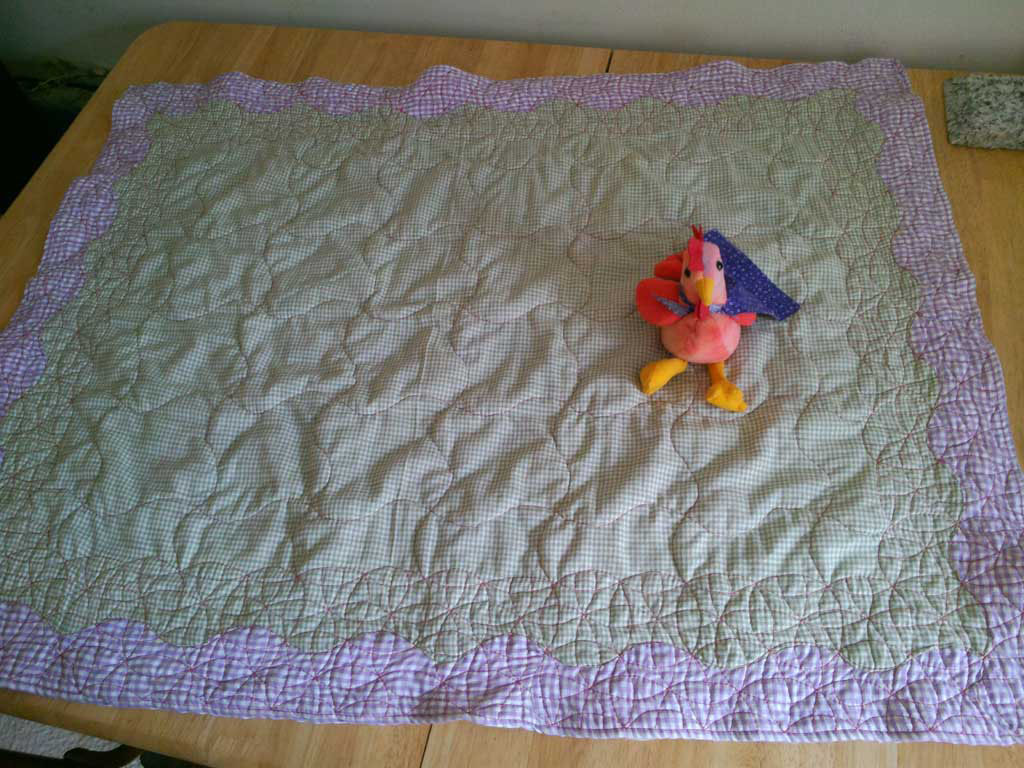
Ok, Chicken says, "It's time to wrap it up." This project's been done, and the next one's well on it's way. So here's a couple of quick tips on how the quilting layout went.

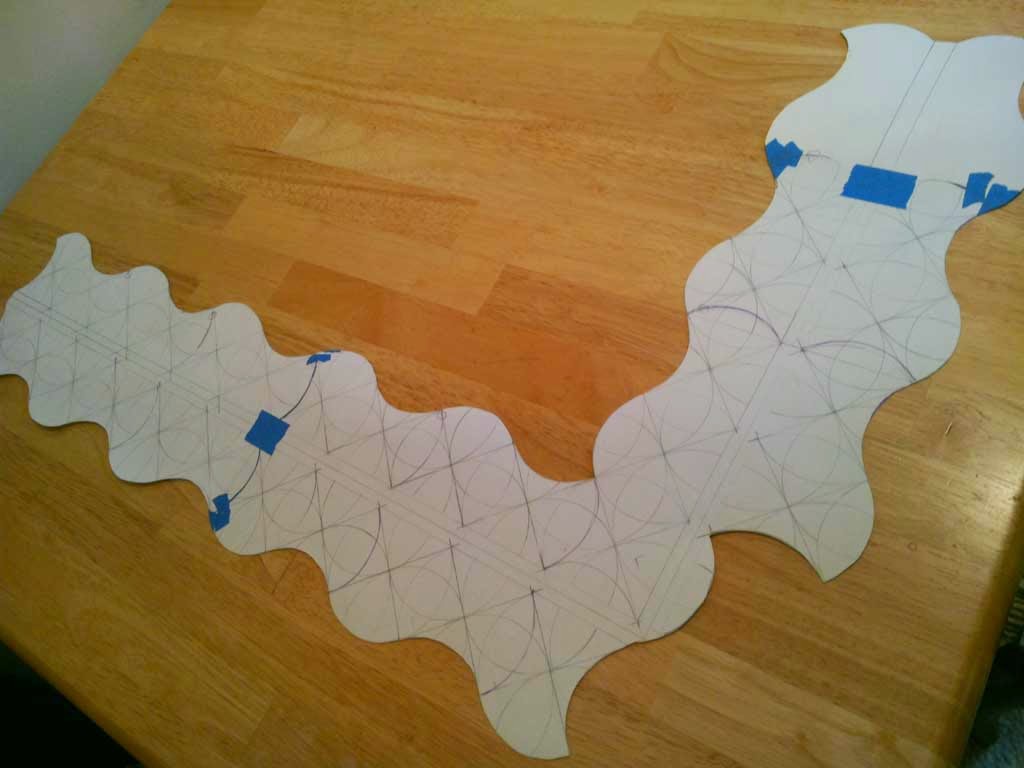
At first I was a bit at a loss for what might be useful, but after trying a bunch of different templates it came down to two. The first one was just to locate the intersections.

  The other template was only for laying out

 the fishes. While the chalk marks were fragile,  with a few different colors of chalk to make the new marks easier to identify it went pretty smoothly, if slowly.


 I realize that  people who sew much don't need many hints, so I'm taking a break and letting Chicken finish this up.


Chicken was in no way inconvenienced, (He likes the cape).


Tuesday, May 26, 2015

Quilting Single Wiggle Square BabyBlanket

Everything about this quilt was more straightforward than the last one. No surprise, this one was tested better and sewed over and over till it worked reasonably well. Both the corners and the curvy joins (slightly visible on each edge) required ripping out and resewing several times to work. There was another surprise when it came time to make the back. Using the template for the border as a guide it wasn't too challenging to make a pattern the size the field should have been.


 The template for the back was made to equal the six square width of the field. The squares of the field were cut out with a quarter inch tab all around. After sewing, the whole field had drawn up enough to hide about a quarter of an inch under the template for the back. So instead of adding a quarter inch for a sewing tab when I cut it out, I trimmed off a quarter inch all the way around.

  Looking closely you can find the curvy joins and fancy corners in the picture on the right. The joins hid better than the corners, but it all worked well enough to use it again.                        


After batting, pinning, and basting shut the whole thing shut, it got it's batting secured at the edge and shaken ever which way. Laying flat it was safety pinned around the border checking to be sure front and back were lined up. The edge of the border was then hand sewed, then machine sewed from the top along with the rest of the wiggly squares.


The resulting slight stagger (mostly less than an eighth of an inch) bugged me some, but I'd do it again.

Ok baby-steps, that's a wrap.


Monday, May 25, 2015

CYCLOCENTRIC SINGLE WIGGLE SQUARE-BEGINNINGS

I've been looking forward to making something with Single Wiggle Squares for a while now. Because this network is most easily generated by a grid of regular squares I tend to think of it as a fourfold network. This network generates circles of four fishes surrounding flower like figures sharing fishes with the four surrounding circles. Quilting this pattern is accomplished with pairs of wavy lines running two directions. Once again the colored pencils allowed me to change colors instead of erasing my error. This was my third poster paper sheet of this network. In the end I filled the whole sheet and then some making patterns for the back and border, cutting and taping as necessary.

Instead of bigger squares with the full quilting everywhere, I made them as small as I felt would be workable on the sewing machine. Outlining each piece
(single wiggle squares this time) and filling the half a square wide border plus a half square of each outside square in the field (center of wiggly squares).

I went through enough weirdness with odd fabrics in my first few projects. This time, it's all calico and gingham. If I counted right there are 13 kinds of calico and 2 kinds of gingham. It would have been simpler to make the whole back and border one piece. Instead I wanted to give the synced up front to back border one more try, with the quilting uniting the simplified center field with the barely marked, fully quilted border. Ideally, every fabric join should fall under a wiggly line of quilting.


 There were four of these made of gingham sewn together to make the frame/border, but first there were several traced on bakers parchment, cut out, folded up and test fitted around the field to make sure they'd fit. Several didn't fit, but eventually the corrections yielded the one below which led to what is probably the correct pattern at left. Baker's parchment is weird stuff. It's fairly transparent, but it won't hold tape or glue-stick worth a damn. It was however always in the kitchen and cheaper than vellum or some other tracing paper.


Saturday, May 23, 2015

IF NOT FOR TEDI-CAM, POTHOLDER

If not for Tedi-Cam, well it's all there on the potholder. These images are both from my book "My First Hundred Teefes", so far published only on Kindle ( Except for 19 copies). They like all the images in the book were black and white line drawings.

The "Hyah" baby blanket didn't make it this time. So for now this potholder is on the short list of "My First Hundred Teefes" ephemera.


 I hope one day to get some better pictures but for now I'm just glad I got it finished and under the care of Dr Mo.

FIRST DOUBLE WIGGLE SIMPLIFIED BABY BLANKET MAILED

The Cyclocentric Double Wiggle Triangle Simplified baby blanket, to be more precise, is completed. Quilted, hand washed, and hanging to dry in the sun, seems to me to have an extra wide border. Flaws and all, I'm pleased enough with it that I've already begun plans for the next "simplified" test. It looks a little dark, it would it's still damp. I was still a little shy about this one. Even though my front to back border matching method wasn't great this time, I hope to get it eventually. It is proof of concept. I only got a few pictures of it, but there's time it stayed in the family.


I'm sure it'll be more opaque when it's dry. As it is it looks almost stained glass like from some angles.


Friday, May 22, 2015

Cyclocentric Single Wiggle Triangle Baby Blanket

I may always be a bit behind with my articles. Fortunately I still have some pretty good pictures of this one, even though I've done two more since then. Recent experiments using only wiggly lines in the border (except the outside edge) with varying density and complexity of the quilting, have led to more descriptive names. For instance, since this blanket's Cyclocentric polygons are bounded by straight lines out to the edge, I would refer to it, and the larger version with a similar treatment, as "primitive". That would make this a Cyclocentric Single Wiggle Triangle Primitive baby blanket.

                                               
The quilting itself was a three-fold pattern where
pairs of wavy lines going in three directions produced
 all the fishes and circles.

This more organized approach was a lot less
challenging and neater.   

The corner folding method was carried over from the Single
Wiggle Triangle Primitive blanket that came just before it.
I really liked the pleaty way I folded the corners to make
them one piece. Unfortunately, none of the templates survived.